
Blog
10 Tips on Getting Better Feedback from Beta Readers

Chris Baty
August 27, 2026
So you’ve spent the summer hidden away in your revision cave, furiously editing your NaNoWriMo manuscript. And now your book has progressed enough that it’s time for a friend or fellow writer to read it (eeep!) and give you feedback that will make the next draft even better (hooray!).
This is a huge moment. I’ve been fortunate to have readers whose generous insights made my manuscripts 10,000% better. But I’ve also bungled the feedback process in inventive ways: wasting readers’ time, collecting reams of confusing notes, and ending up adrift and demoralized.
If I could travel back in time, I’d give Younger Chris Baty these 10 tips to make the feedback process smoother and more fruitful for all involved.
…The First Chapter: How to Revise Your Way to Something Great!

Kathy Kitts
August 11, 2026
When revising our NaNoWriMo novels, it’s important to polish our first chapter to make it easy for our readers to fall under the spell of our story and enjoy the worlds we create. Yet, what should a great opener include that will make our readers excited to turn the page?
…NaNoWriMo in the Classroom: Prep Tips for Your Students

Laura Bradley
August 6, 2026
My student Garrett insisted he didn’t need to do any of the prep work for writing his novel. “That’s just not how I write, Mrs. Bradley. I’ve got the basic ideas in my head, and when I write, those ideas just flow onto the paper. It works for me!”
Younger Teacher Me might have given Garrett permission to skip the prep work and start writing, but Older Teacher Me knew better. Students might resist putting plans to paper (just like some adult writers we know), but it is a valuable part of the writing process and can be especially helpful in the midst of writer’s block.
…NaNoWriMo in the Classroom: Prep Tips for Teachers
Laura Bradley
July 28, 2026
“Write a WHAT, Mrs. Bradley?”
“How long does it have to be?”
“Can we write ANY story? Like, ANYTHING we want?!?”
“Wait, what’s a novel?”
It was early October, my students were well into our school routine, when I took a sharp detour, ditched my current lesson plans, and challenged my 8th graders to write a novel in a month. At that point I hadn’t done a lot of planning for NaNoWriMo, but I hoped my students would be as excited about the project as I was.
…
My Three Biggest Revision Mistakes
Chris Baty
July 24, 2026
I’ve come to love the editing process. Sure, the first draft is an unforgettable joyride. But it usually takes me a few drafts to discover the juiciest, most memorable parts of my story.
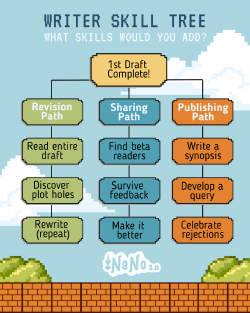
Staying focused and motivated long enough to get to those “eureka!” moments, though, is a huge challenge for my brain. In honor of Revision Summer, I’ve pulled together the three biggest editing blunders I’ve made, along with some tips on how you can avoid them.
Let my pain be your gain!
…
The Game of Revision: How Do You Stay Motivated and Win?
Kathy Kitts
July 14, 2026
How do you, dear Wrimos, navigate the boring, annoying, and sometimes icky parts of the revision process? How can you/do you gamify it?
…
No More Flurgling: How to Whip Your Dialogue Into Shape
Dialogue can make up anywhere from 10 to 50 percent of a novel. Getting it to sound like two or more people legitimately talking to each other doesn’t have to be a drag. Here are a few easy ways to whip your dialogue into better shape.
…
3 Quick Tips for Finishing That Draft
Don’t leave your NaNo project hanging. You have everything it takes to finish that sucker already within you. Here are 3 quick tips to move you into the Finish Column.
…
Scaffolding: What It Is, Why It Appears in First Drafts, and How to Revise It Away
Kathy Kitts
June 16, 2026
Just as we use scaffolding to construct buildings, we use specific writing devices, tools, and tricks to create fiction. However, as we must remove the braces and platforms before putting the home on the market, we must identify and remove these structural supports from our stories before submitting them. We need such tools to write the story, but leaving them lying about afterward–like a table saw in the middle of the living room–distracts the readers and gets in the way of their enjoyment of the story.
…
Wacky Ways to Whip Your Writing Into Winning Form
You might think revising is a rough and rigorous ritual: a rigid writing desk, a ruthless red pen, a wrinkled brow, and seventeen cups of tea that regretfully go cold. You read and re-read the same wayward writing until the words wobble and warp, and no longer look like words at all.
But revising does not need to be dreadfully dull. A little silliness can shake loose the details your brain has stopped seeing and make you a sharper editor.
…